
H2A-member in the spotlight: Hydrogenious LOHC Technologies
Making hydrogen transport safe, simple and efficient
The German company Hydrogenious LOHC Technologies is one of the most innovative players in the hydrogen industry. It has developed a Liquid Organic Hydrogen Carrier (LOHC) system on the basis of benzyltoluene (BT). Hydrogen is bound to the LOHC-BT through a hydrogenation process. The oil-like substance allows for easy and cost-efficient logistics using existing infrastructure for seafaring vessels, barges, trains and trucks. The hydrogen will subsequently be released at the point of destination via a dehydrogenation process. The unloaded LOHC-BT carrier can be returned and reused many times over. The result is efficient hydrogen storage and transport at ambient temperature and pressure, providing a safe, flexible and competitive solution for large-scale hydrogen logistics.
Building the LOHC bridge
Hydrogenious was founded in 2013 and has been able to attract a multitude of high-profile investors, including AP Ventures, Royal Vopak and Mitsubishi Corporation, amongst others. The company pursues a clear ramping strategy. On a smaller scale, the Multi-SOFC demonstration project in Erkelenz, Germany, combines Hydrogenious’ LOHC technology with solid oxide fuel cells to supply the local hospital with reliable, low-emission electricity and heat. With a hydrogen release capacity of 7.5 tonnes per year, it will demonstrate the safe decentralised supply of critical infrastructure in inland locations after commissioning at the end of 2026. Hydrogen-loaded LOHC is non-explosive, hardly flammable and eliminates boil-off, offering a particularly safe local application of hydrogen infrastructure.
A first commercial-scale project is Green Hydrogen @ Blue Danube, located in Bavaria, Germany with a planned annual hydrogen release capacity of 1,800 tonnes and 160 tonnes of storage capacity. The project received IPCEI (Important Project of Common European Interest)-status by the European Commission, which marks it as a contributor to the clean transition and competitiveness of the European Union. Upon commissioning, the project will avoid up to 16,000 tonnes of CO₂ per year, by providing clean hydrogen for the decarbonisation of industries in the larger Danube region. Hydrogenious signed a contract with the Griesemann Gruppe in October 2025 for the Front End Engineering and Design (FEED) of the project. Dr Andreas Lehmann, CEO of Hydrogenious emphasises: “Pilot projects such as Green Hydrogen @ Blue Danube play a crucial role in the current phase of the hydrogen market: they translate innovative technologies into tangible infrastructure and pave the way for larger-scale deployment. From a European perspective, it is essential to advance these projects now, thereby strengthening energy security and independence while securing Europe’s technological leadership in clean hydrogen solutions.”
Moreover, Hydrogenious is already working on scaling the supply chain further through its LOHC Bridge project, launched in January 2026. This project explores the techno-economic feasibility for LOHC-routes from Morocco and Egypt to Europe and seeks to leverage the exceptional renewable energy sources in the North African countries to create an at-scale supply chain. Key elements of the project scope include the identification and evaluation of suitable locations, the design of a comprehensive LOHC Storage Plant concept and a detailed economic analysis of various hydrogen supply chains. These supply chains will be assessed for exports to selected European ports in the Netherlands, Germany and Southern Europe.
Hydrogenious in the port of Amsterdam
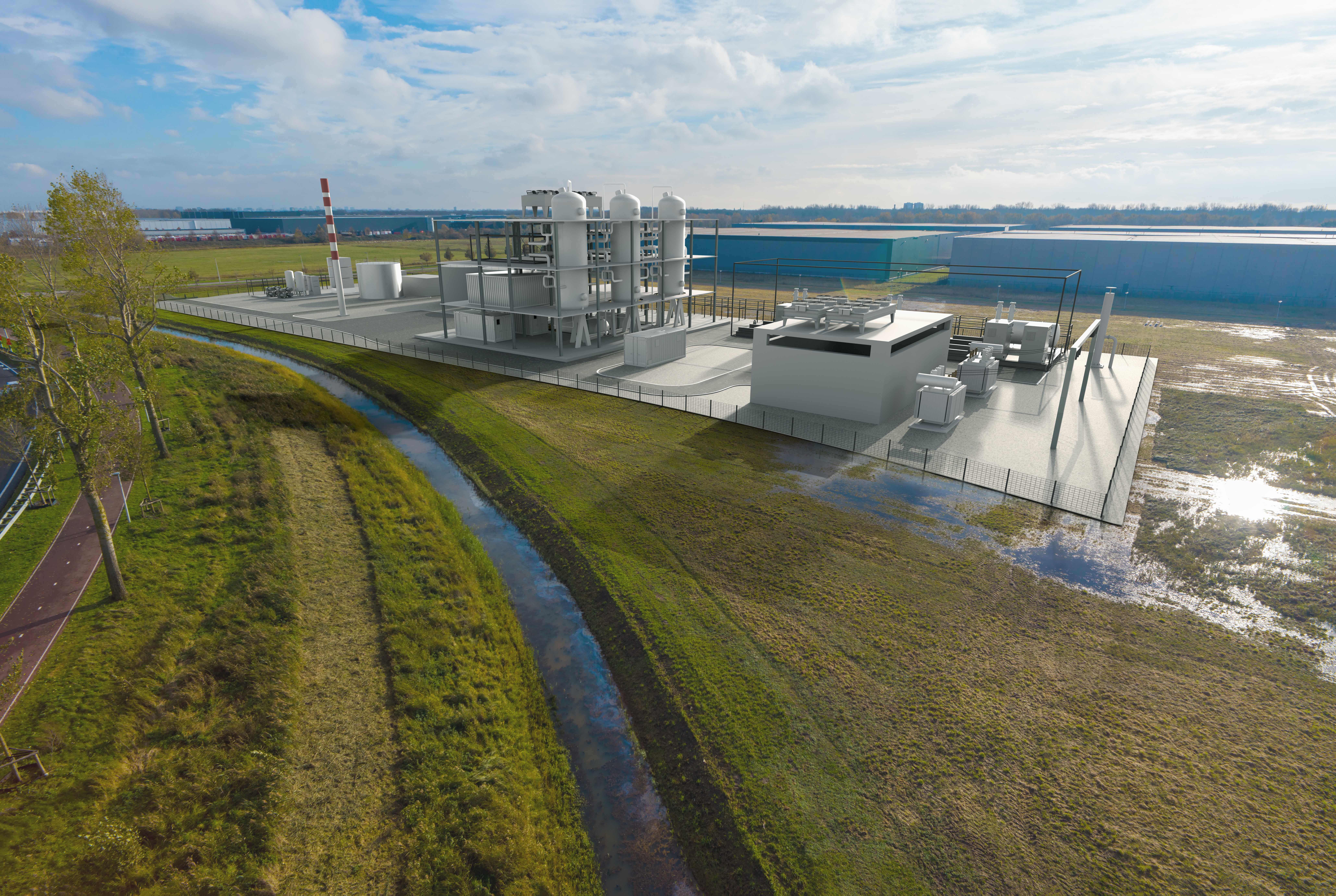
Amongst the envisioned ports for large-scale hydrogen import via LOHC is the port of Amsterdam. Hydrogenious has been a prominent member of H2A since the latter’s inception, underlining the German company’s strong link to the Amsterdam area. Hydrogenious signed a Memorandum of Understanding with Evos and Port of Amsterdam in October 2022 for the joint development of a large-scale hydrogen import facility. The facility will comprise a LOHC-BT dehydrogenation plant, with a release capacity of 36,000 tonnes per year, and the leveraging of storage capacity at one of the Evos terminals in the port of Amsterdam. The efficiency, cost-effectiveness and flexibility of the Hydrogenious technology and its use of existing infrastructure, make it a unique match with the prominent position of the port of Amsterdam in global energy supply chains. “Large-scale hydrogen imports will be essential to Europe’s future energy system and to the successful decarbonisation of hard-to-abate sectors. As one of Europe’s major future hydrogen import hubs, the port of Amsterdam will play a pivotal role. Given the stringent safety requirements involved, the partnership between Hydrogenious and Port of Amsterdam is crucial to advancing the necessary import infrastructure.” says Andreas Lehmann. The LOHC Bridge project among others has the potential of making the port of Amsterdam an important node in the hydrogen supply chain of the future. The stated ambition of Hydrogenious that underpins all these activities matches closely with the goals of H2A: ‘Unleash the potential of clean hydrogen and make a common global vision come true.’
Photocredit: Planned LOHC Release Plant at the Port of Amsterdam © Hydrogenious LOHC