
Port of Amsterdam and duisport Highlight Potential of Hydrogen Imports
Fraunhofer UMSICHT, a renowned research institute, has published its RE-Chain report, focused on how the supply chain for green hydrogen can bolster energy resilience. The report has been jointly commissioned by H2A-member Port of Amsterdam and duisport, the port authority for the German port of Duisburg and focuses both on multiple overseas import vectors and miscellaneous transport modalities for last-mile delivery.
Technical readiness
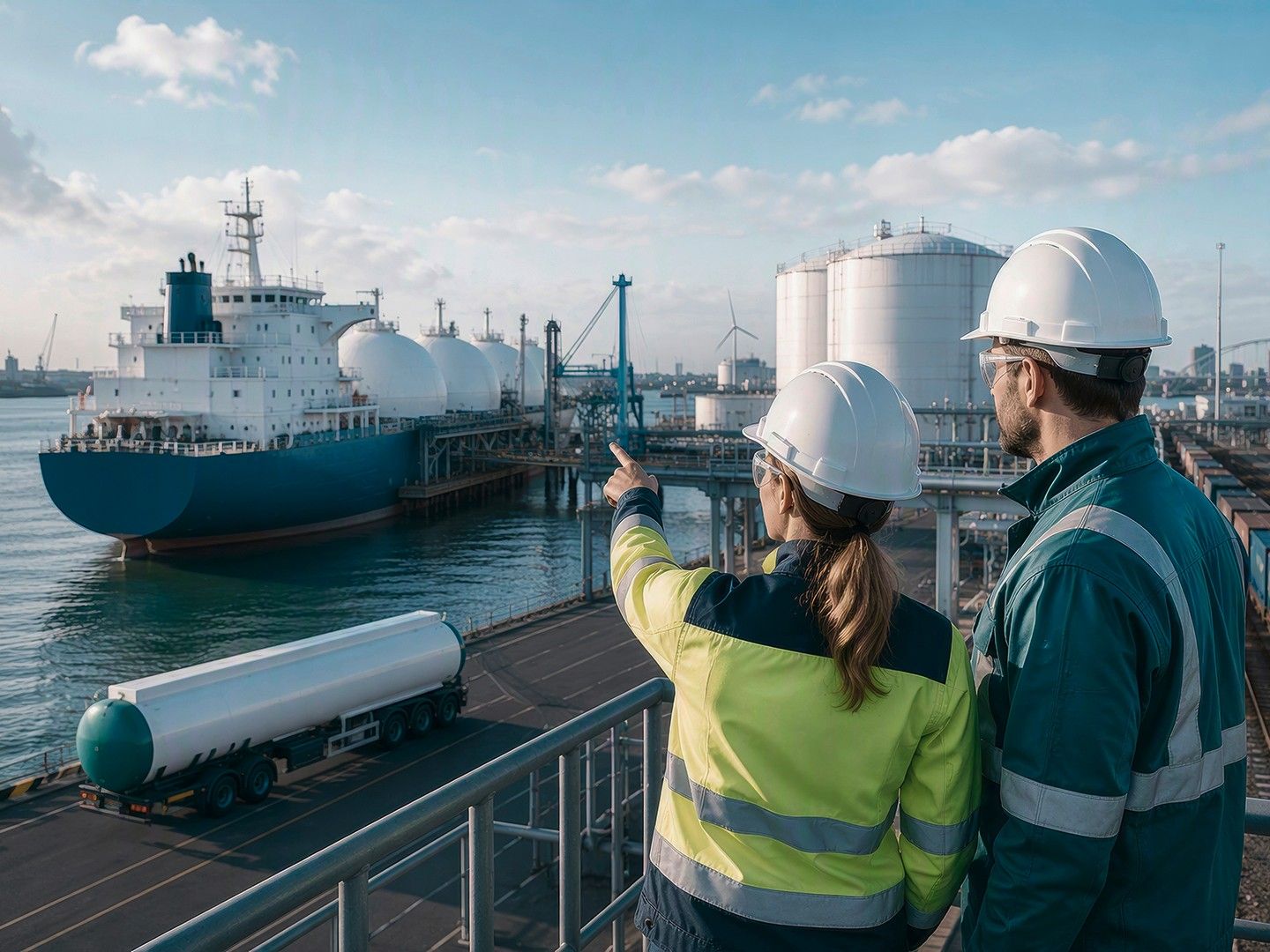
The study focused on delivery of green hydrogen produced in either Spain or Oman to the port of Amsterdam, as liquid hydrogen (LH₂) or via Liquid Organic Hydrogen Carriers (LOHCs), with subsequent transportation to the port of Duisburg for final distribution to industrial end users. The port of Amsterdam features two large import projects for the two vectors, with EcoLog working on a LH₂ terminal and Evos on a LOHC terminal. The study underlined that both these routes show technically feasibility for large-scale importation of hydrogen.
Ports boast robust positions to scale hydrogen supply chains
Fraunhofer showed that demand for hydrogen in the Rhine-Ruhr Area is expected to grow from 870,000-1,170,000 tonnes in 2030 to 3,870,000-5,370,000 tonnes by 2045. The expectation is that over 90% of these volumes will be imported. This calls not only for sufficient infrastructural capacity, but multiple supply chain routes and flexibility in transport modalities. Through their strategic locations, existing energy infrastructure and excellent connections via inland waterways, rail and road and future hydrogen pipelines, the ports of Amsterdam and Duisburg are well positioned to provide a reliable, scalable and competitive supply of green hydrogen to European industries, like the chemical industry, steel manufacturing and other energy-intensive sectors.
Energy resilience
The versatility in delivery options and the ability to scale, mean that both ports can make a large contribution to European energy resilience, as the green hydrogen supply chain has no singular dependency and can provide a new energy source to the existing energy mix. The researches note that the technology is no longer the biggest challenge. Taking the next step hinges on demand creation, long-term offtake contracts and investment security. Close collaboration between industry, logistical partners, ports and governments will be key to create these preconditions.
H2A has a big role to play
Such collaboration forms the foundation of H2A’s approach. With Port of Amsterdam, EcoLog and Evos as key members, H2A focuses on ensuring that the potential identified by Fraunhofer is realised. Through the infrastructure developed in the port of Amsterdam and the creation of robust and diversified distribution methods to the port of Duisburg, economic and strategic value can be realised, on a regional, national and European level.