
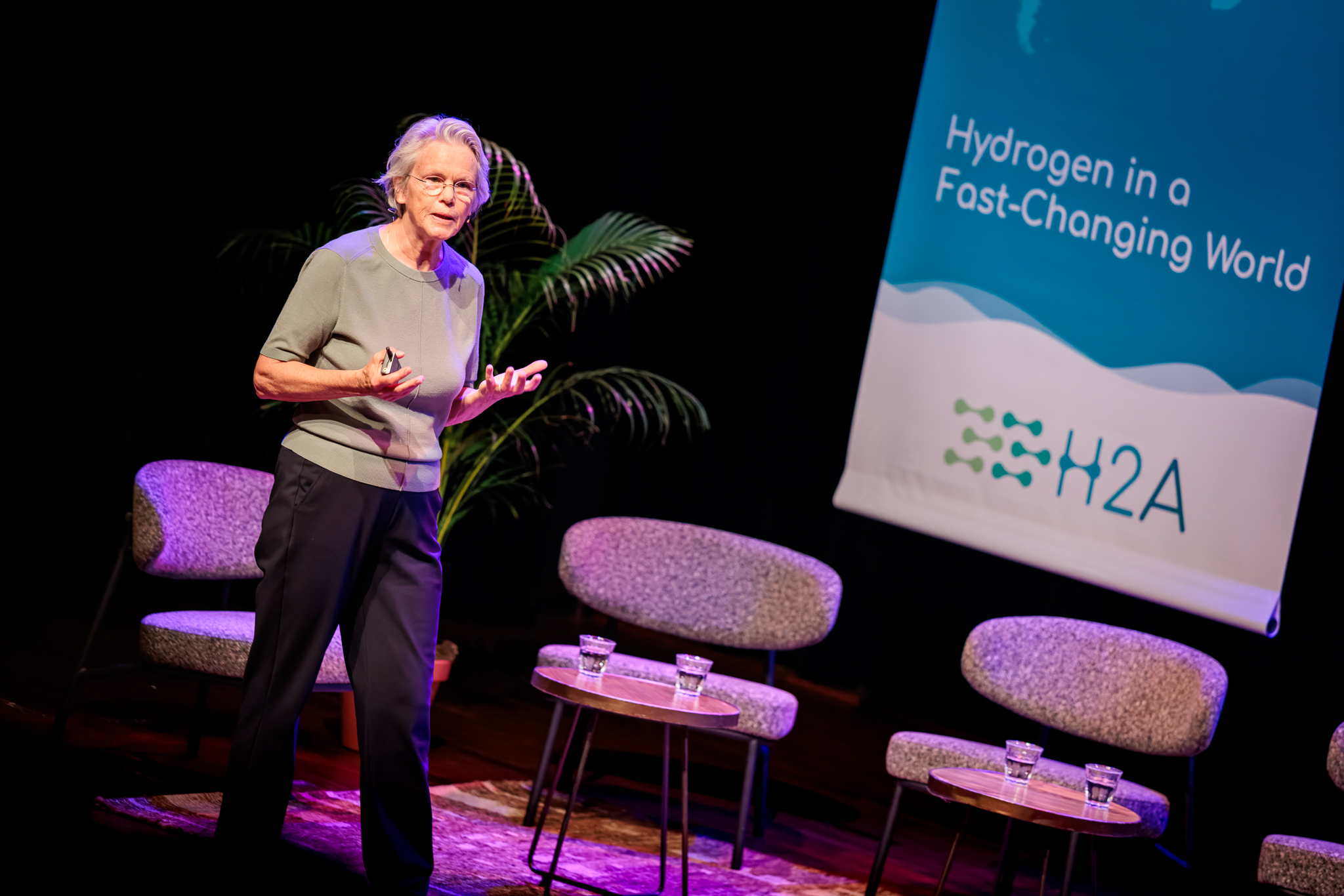
Energy Transition in an Age of Strategic Rivalry: Lucia van Geuns Opens the H2A Symposium 2026
The 2026 H2A Symposium opened with a keynote from Lucia van Geuns, Senior Strategic Advisor Energy at The Hague Centre for Strategic Studies (HCSS), who explored how the energy transition is increasingly shaped by geopolitics, economic competition, and questions of energy security.
In her keynote, Energy Transition in an Age of Strategic Rivalry, Van Geuns challenged the audience to look beyond technology and climate targets alone and consider the broader global context in which the hydrogen economy is developing.
A World in Transition
Van Geuns described a world characterized by growing geopolitical tensions, volatile energy markets, increasing policy uncertainty, and heightened competition over technology and supply chains. From disruptions in global energy markets to concerns around critical minerals and industrial competitiveness, these developments are reshaping the conditions under which the energy transition must take place.
She highlighted how Europe finds itself navigating an increasingly complex global landscape, balancing climate ambitions with economic competitiveness and energy security while operating between the geopolitical influence of the United States and China.
Security, Competitiveness and Decarbonisation
A key message throughout the presentation was that the transition away from fossil fuels is no longer driven solely by climate considerations.
According to Van Geuns, energy security, resilience, and industrial competitiveness are becoming equally important drivers of energy policy. Recent geopolitical developments and disruptions to global energy markets demonstrate the importance of building resilient energy systems capable of withstanding future shocks.
She argued that Europe should move towards an integrated, security-driven energy strategy that combines decarbonisation objectives with measures to strengthen resilience, diversify supply chains, and improve competitiveness.
Europe’s Challenge
Drawing on the findings of the Draghi Report, Van Geuns noted that Europe faces significant challenges, including high energy prices, slower economic growth, increasing international competition, and continued dependence on imported energy.
While the destination of the energy transition is broadly understood, she stressed that the real challenge lies in successfully navigating the path towards it.
As she concluded: “The challenge today is not so much the end state, the new energy system. That will come. Successfully navigating the transition in an increasingly complex and geopolitically fragmented world, that is really the challenge.”
Hydrogen’s Role
Against this backdrop, Van Geuns positioned hydrogen as a critical enabler of Europe’s industrial transition.
While electricity will remain at the centre of the broader energy transition, hydrogen will play an essential role in decarbonising hard-to-abate sectors, supporting industrial competitiveness, diversifying energy imports, and strengthening Europe’s resilience.
Her concluding message captured the central theme of the symposium: “Electrons will power Europe’s energy transition, and hydrogen will secure its industrial transition.”